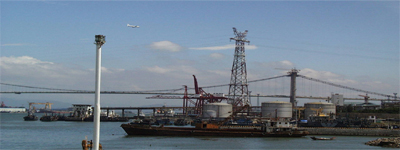
XIAMEN (ALSO NAMED AMOY, in Chinese
read 廈門)
Xiamen was founded the mid-14th
century, in the early years of the Ming dynasty. There had been a town here since Song
times, but the Ming built the city walls and established Xiamen as a major seaport and
commercial center. On the 17th century it became a place of refuge for the Ming
rulers fleeing the Manchu invaders. Form here Ming armies fought their way north again
under the command of the pirate general Koxinga.
From 1516 the Portuguese, based on an
island close to Xiamen, traded surreptitiously with the Chinese for 50 years. The Chinese
government is supposed to have finally discouraged the Chinese traders by lopping the
heads off 90 of them. In 1575 the Spanish arrived and succeeded in building up a
substantial trade in raw silk which was shipped to Manila and then to Mexico, but that
also came to an end.
The Dutch arrived in 1604 but failed
to gain a footing in Xiamen. After seizing Taiwan, however, they maintained a secret trade
from the island of Quemoy until Koxinga appeared and put an end to their commercial
aspirations. The opportunity offered by the Dutch expulsion was taken up by the British,
who opened up trade with the new regime on Taiwan and even established a base in Xiamen.
However, by the early 1700s trade with Westerners only took place intermittently and
secretly.
Things changed dramatically with the
Opium wars of the 19th century. In August 1841 a British naval force of 38
ships carrying artillery and soldiers sailed into Xiamen harbour, forcing the port to
open. Xiamen then came under the control of an assortment of foreigners, mainly the
century the Belgians, Danes, French, Germans, Dutch and Americans all had consulates here.
The close, offshore island of Gulangyu was established by the European settlers as a
foreign enclave.
When Chiang Kaishek fled to Taiwan in
1949 he left Quemoy(now called Jinmen) and Matsu (Mazu) islands armed to the hilt with
Kuomintang troops, hoping to use them as stepping-stones to invade the mainland from
Taiwan. In 1958 the Pwople’s Liberation Army started
bombarding the islands with artillery shells. In the West this crisis is only dimly
remembered but, at the time, the USA and Taiwan had a Mutual Security Treatu and it seemed
that the USA was about to enter a war for the sake of Chiang’s pathetic regime. Kuomintang troops still occupy the islands.
Quemoy is within view of Xiamen.
Today, Xiamen is a bustling place. It
was opened to tourists in 1980 and in the following year became a Special Economic Zone in
the hope of attracting Taiwanese investors, just as Shenzhen was made an SEZ to entice
Hong Kongers.
Overseas Chinese are now permitted to buy homes and
live in Xiamenon a permanent basis if they so desire. The original idea was to attract
Taiwanese pensioners to retire and spend the remainder of their days(and their pensions)
in the ‘homeland’. Instead, the chief result has been to attract real estate
speculators-Overseas Chinese who buy luxury flats and villas in the hope of selling them
later for a tidy profit. Speculation has indeed caused a building boom, and real estate
prices in Xiamen have been going through the roof. Fortunately, most of this new
development is taking place in the suburban districts and the central part of Xiamen near
the waterfront retains its very unusual(for China at least) colonial architecture.
Gulangyu is especially well preserved, A laid-back town of over 300,000 people, Xiamen has
a very different feel from China’s inland towns,
making this a worthwhile place to visit.